BoredomBusted — Find Your Next Favorite Thing To Do
Discover hobbies, activities, places, and ideas that spark joy. Whether you're looking for something creative, active, social, or relaxing, BoredomBusted helps you find your next favorite thing to do.
Browse our hobby guides, things-to-do collections, and place ideas to never be bored again.
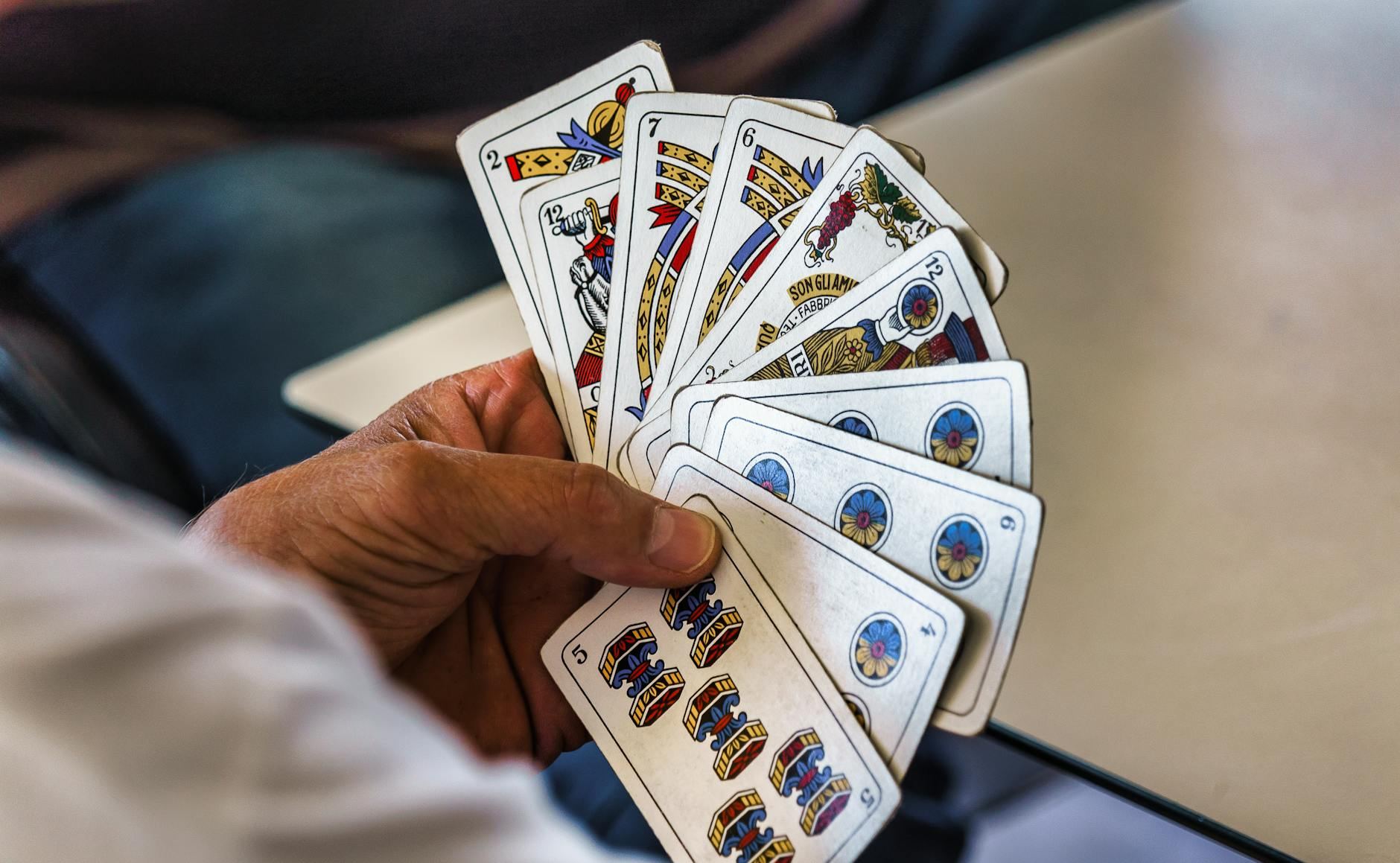
Two players. One deck.
Infinite ways to waste an afternoon (or...maybe ruin a friendship!).
This list covers 80+ card games built for two, split into two categories: traditional card games (grab a deck and go) and trading card games (build a deck, collect cards, go deep). They're a different beast — more on that when we get there.
Traditional card games are the no-excuses option. Standard deck, two people, and you're playing. Most of these have been around for decades — some for centuries — because the core mechanics are just that good.
These are the easiest entry points. Rules take five minutes, gameplay is intuitive, and most use a standard 52-card deck you already own.
The purest card game ever made — and the most luck-dependent. Each player flips a card; highest card wins the pile. First to collect the whole deck wins. Zero strategy, maximum drama. Great for kids or anyone who just wants something brainless and fast. 10–20 min | Standard deck
Speed meets concentration. Players flip cards onto a central pile — when two matching cards appear back to back, first player to slap the pile and yell "Snap!" takes it. Loud, fast, and genuinely fun. 5–15 min | Standard deck
Both players race to shed their cards simultaneously onto shared piles — no turns, pure chaos. Think of it as Speed's more frantic cousin. The first player to empty their hand wins, and it's not as easy as it sounds. 5–10 min | Standard deck
Similar to Spit but slightly more structured. Players lay cards in sequence onto two central piles, racing to empty their hand first. Reaction time matters more than strategy. 5–10 min | Standard deck
A slapping game with more rules than it deserves. Players flip cards onto a central pile — certain combinations (doubles, sandwiches, sequences) trigger a slap. First to slap correctly takes the pile. Gets heated fast. 10–20 min | Standard deck
A dead-simple shedding game — players alternate playing cards onto a central pile, trying to offload their hand. Almost entirely luck-based, which makes it a solid low-stakes option. 10–20 min | Standard deck
A solitaire-style game for two. Players take turns laying cards on a shared layout in descending order and alternating colors, Kings occupy corners. First to empty their hand wins. Easy to teach, satisfying to play. 15–25 min | Standard deck
Don't let the name fool you — this is a legitimately entertaining shedding game. Players work through three layers of cards (hand, face-up, face-down) trying to offload everything. Special cards flip the game on its head mid-round. Known under different names worldwide. 15–25 min | Standard deck
These reward players who think ahead. Expect longer sessions, more complex rules, and significantly more replayability.
The gold standard of two-player card games. Players draw and discard to build sets (three of a kind) and runs (sequential same-suit cards), then "knock" to end the round. Reading your opponent's discards is half the game. Easy to learn, genuinely hard to master. 20–30 min | Standard deck
The broader family that spawned Gin. Same core mechanic — form sets and runs — but with more flexible rules depending on the variant you play. A reliable fallback when you want something familiar with room to experiment. 20–40 min | Standard deck
One of the oldest card games still played competitively. Players form card combinations for points, scored on a distinctive peg board. The "crib" mechanic — where both players contribute cards to a shared hand scored by the dealer — adds a layer most games don't have. 30–45 min | Standard deck
A rummy-style game where the goal is forming melds of seven cards of the same rank. The two-deck setup and joker mechanics add complexity that keeps experienced players engaged. Dominated American living rooms in the 1950s for a reason. 45–60 min | Two standard decks + jokers
Austria's national card game, and one of the sharpest trick-taking games you can play with two people. Played with just 20 cards, every decision carries real weight. If you like Gin Rummy but want something with more teeth, start here. 20–30 min | 20-card deck
A 16th-century French game still worth playing. Players score points through declarations (combinations in hand) and trick-taking, with a tight 32-card deck. Complex but deeply rewarding for players who want a real challenge. 30–50 min | 32-card deck
A trick-taking and melding game that was Winston Churchill's favorite — which tells you something about the kind of person who enjoys it. Played with a 64-card double deck, scoring comes from specific card combinations. 45–60 min | 64-card deck
A classic American trick-taking game with a melding phase before play begins. The 48-card deck and point-scoring system take a session or two to internalize, but it's a genuinely strategic game once it clicks. 45–60 min | 48-card deck
A Dutch trick-taking game with a bidding mechanic and a unique trump system. One of the better lesser-known strategy games for two — tight, fast-playing once you know it, with real decisions every hand. 30–45 min | 32-card deck
A German trick-taking game where the target is 66 points — and the tension comes from deciding when to close the game early. Short, sharp, and tactically interesting. 20–30 min | 24-card deck
The predecessor to Bridge, and still worth playing on its own terms. Trick-taking with no bidding — just play your cards and read your opponent. Clean, simple, strategic. 30–50 min | Standard deck
A fishing game where players capture cards from a central layout by matching or combining them to hit target values. Unusual mechanics make it a refreshing break from trick-taking games. 20–30 min | Standard deck
A French trick-taking game with a twist: before play begins, players can exchange cards from their hand — but doing so scores points for the opponent. Every exchange is a calculated risk. 25–35 min | 32-card deck
A Bavarian game with an unusual mechanic: players bluff about which suit and rank will be trump before cards are revealed. Part trick-taking, part poker. Tournaments are common in Bavaria. 30–45 min | 32–33-card deck
A Central European trick-taking game where only sevens and the lead card's rank can win a trick. Sounds simple — plays surprisingly deep. Popular in the Czech Republic and Slovakia. 20–30 min | 32-card deck
A fast Spanish betting game where players challenge each other based on hand strength — and bluffing is not just allowed, it's the point. One of the oldest card games in Spain. 10–20 min | Spanish 40-card deck
A two-player adaptation of Germany's most popular card game. The three-hand Skat mechanic is preserved using a dummy hand, keeping the game's strategic depth intact. 30–45 min | 32-card deck
The two-player version adjusts draw rules to compensate for the missing players — but the core meld-building strategy stays the same. Worth noting separately because the two-player experience plays quite differently from the four-player version. 40–55 min | Two standard decks + jokers
No strategy required. These games run on speed, reflexes, and the willingness to look slightly unhinged at a kitchen table.
(See Beginner-Friendly section above)
Already covered above — worth a second mention here because it sits firmly in the reaction-based category. 5–10 min | Standard deck
Same as Speed in DNA, more chaotic in execution. Both games belong in this category. 5–10 min | Standard deck
Strategy creeps in at the margins — knowing which combinations trigger a slap helps — but this is fundamentally a reaction game. The player with faster hands usually wins. 10–20 min | Standard deck
These are the deep cuts. Most require non-standard decks or regional rule sets, but they're worth knowing if you're a serious card game enthusiast.
A Croatian trick-taking game with a unique scoring system built around "belot" — declaring a King-Queen pair of the same suit mid-game for bonus points. Widely played in Croatia and Hungary. 30–45 min | 32-card deck
The national card game of Swabia — a region of Germany — and a legitimate classic. Complex bidding and melding mechanics with a 48-card deck. Often played in tandem with Gaigel in tournaments. 40–60 min | 48-card deck
Binokel's close sibling, also from Swabia. Similar deck, different mechanics — played in pairs in its full form, but adapted well for two. 40–60 min | 48-card deck
(See Strategy-Heavy section above)
A traditional Tyrolean game often described as one of the most complex card games in the world. Serious players only. 40–60 min | 33-card deck
One of the oldest known card games, with references dating to the 16th century. A Renaissance-era trick-taking game still played in parts of Central Europe. 30–45 min | 36-card deck
An elaborate Italian trick-taking game with a 97-card deck that includes zodiac signs and celestial symbols. More of a historical curiosity than a regular play option, but fascinating. 40–60 min | 97-card deck
A Portuguese trick-taking game closely related to the Italian Briscola. Played in cafes and parks across Portugal — quick to learn, pleasant to play. 30–40 min | 40-card deck
(See Strategy-Heavy section above)
A trick-taking game from Niger — one of the simplest in this category, accessible to all ages. Popular across West Africa. 15–30 min | Non-standard deck
A European trick-taking game where declaring a King-Queen pair (the "marriage") of the same suit scores bonus points. Found across Germany, France, and neighboring regions. 25–35 min | 32-card deck
A Russian trick-taking game often played as a gambling game in certain regions. Fast, luck-heavy, and easy to pick up. 20–30 min | 36-card deck
Spain's answer to a serious trick-taking game. Declaring all four Kings or all four Knights — a "tute" — wins the game outright, regardless of score. 30–50 min | Spanish 40-card deck
(See Strategy-Heavy section above)
Regional variants of Schneider and Watten with their own rule sets — worth seeking out if you're already familiar with the base games. 30–45 min | 32-card deck
A Russian trick-taking game whose name translates to "Own Trumps." Players choose their own trump suit, which changes the dynamic significantly compared to standard trick-taking games. 20–30 min | 36-card deck
(See Strategy-Heavy section above)
(See Strategy-Heavy section above)
(See Strategy-Heavy section above)
A Scottish game where players try to avoid certain penalty cards. Mostly luck-based, but its regional character makes it worth a mention. 20–30 min | Standard deck
A historical European game believed to have been a favorite among 16th-century nobility. More of a collector's curiosity than a regular play option. 30–40 min | 40-card deck
A lesser-known trick-taking game with several regional variants — rules vary significantly depending on where you find it. 25–35 min | Standard deck
A French trick-taking game dating to the 17th century. Small player base today, but historically significant. 20–30 min | 32-card deck
A traditional game from Trieste with strategy-heavy trick-taking mechanics. Its name comes directly from its city of origin. 25–35 min | 40-card deck
Trading card games are a different animal. You don't just pick up a deck and play — you build one. Cards are collected, traded, and combined into custom decks that reflect your strategy and playstyle.
The upside: the depth and replayability are unmatched. The tradeoff: there's a real financial commitment, especially in competitive formats. A beginner starter deck runs $10–15. A competitive constructed deck can run hundreds.
If you're new to TCGs, start with the beginner section. If you already play and want to go deeper, skip straight to competitive.
Low complexity. Affordable entry points. Enough depth to stay interesting past the first few sessions.
The most accessible TCG ever made — and still one of the best. Players battle using Pokémon with HP and attacks, with the goal of knocking out six of the opponent's Pokémon. Starter decks are well-balanced and genuinely playable out of the box. The competitive scene runs from local leagues to the annual World Championships. 20–40 min | Customizable deck
The modern Digimon TCG is better than it has any right to be. The "digivolution" mechanic — stacking evolved forms on top of base cards — creates a uniquely layered decision space. Beginner-friendly, with strong starter decks and a growing competitive community. 30–50 min | Customizable deck
Built around the anime's quirk system, this TCG has enough thematic flavor to appeal to fans and enough mechanical depth to keep non-fans engaged. Lower complexity than MTG or Yu-Gi-Oh!, which makes it a solid entry point. 30–50 min | Customizable deck
A newer TCG emphasizing clan synergies — your deck's power comes from how well your cards work together, not just individual card strength. Good introduction to the deck-building mindset. 25–45 min | Customizable deck
A narrative-driven TCG where creatures have individual backstories and abilities. Beautifully illustrated, mechanically approachable, and worth watching if you want something outside the mainstream. 20–40 min | Customizable deck
These games have deep mechanical systems, large card pools, and active competitive scenes. The learning curve is real. So is the ceiling.
The original TCG — and still the benchmark everything else is measured against. Spells, creatures, and artifacts across five mana colors create a strategic space that's been evolving since 1993. Multiple formats (Standard, Modern, Commander, Draft) mean you can find an entry point at almost any budget. The competitive ceiling is as high as card games get. 20–60 min | Customizable deck
Monsters, spells, and traps in a format that rewards players who study the current meta obsessively. The ruleset has grown complex over decades of expansion — veteran players will tell you the learning curve is steep, and they're not wrong. The payoff for mastering it is a globally competitive game with a massive player base. 20–50 min | Customizable deck
The newest serious entrant in the competitive TCG space. Hero-centric gameplay — each player picks a hero with a unique playstyle — creates matchups that feel genuinely different every time. Grown rapidly since launch and now has a legitimate professional circuit. 40–60 min | Customizable deck
Japan's second-biggest TCG after MTG. Players ride units to become the "Vanguard" and call support units to the field. The damage mechanic — where taking damage also draws from your deck — creates constant tension around the 6-damage loss condition. 20–40 min | Customizable deck
Built by the same designer as Magic: The Gathering, Duel Masters strips MTG's complexity down to a faster, cleaner system. Huge in Japan, still active globally. Worth exploring if you want MTG's DNA without the full ruleset. 20–40 min | Customizable deck
These games are built around existing IP. The mechanical depth varies — some are legitimately competitive, others are primarily collector experiences. All of them are more fun if you already love the source material.
Lets players recreate iconic matchups from the series — Goku vs. Vegeta, Tournament of Power lineups — using leader cards that flip between two forms mid-game. Mechanically solid, visually spectacular. 30–50 min | Customizable deck
A cooperative living card game where players team up as Marvel heroes against villain scenarios. The 1–2 player cooperative format is unusual in the TCG space and works well — no need to build a competitive deck, just pick a hero and fight. 45–90 min | Pre-built / customizable deck
Light side vs. dark side, built around objectives rather than direct player attacks. The Force struggle mechanic adds a layer that feels true to the source material. 30–60 min | Customizable deck
A cooperative living card game — players work together to complete quests rather than compete against each other. One of the best two-player cooperative card game experiences available. 30–60 min | Customizable deck
A Japan-exclusive TCG based on the Fire Emblem series. Characters from across the franchise appear on cards, making it a collector's dream for fans. Mechanically interesting, though the import barrier limits accessibility outside Japan. 30–50 min | Customizable deck
Characters from across the entire Final Fantasy series — from FF1 through the latest releases — appear in a mechanically clean TCG system. The art alone makes it worth looking at. 30–50 min | Customizable deck
The oversized character cards that physically transform from bot mode to alt mode are the gimmick — and it actually works. More novelty than competitive depth, but a genuinely fun experience for fans of the franchise. 20–40 min | Customizable deck
A hybrid that blends traditional card battle mechanics with board game-style territory control. Gaining traction in Asia, still emerging globally. 30–60 min | Customizable deck
Combines card battles with dice mechanics, introducing variability that pure card games don't have. Aimed at players who want something between a TCG and a tabletop game. 40–60 min | Customizable deck + dice
A Japanese TCG with spirit, spell, and nexus cards. Multiple anime adaptations have kept its player base engaged for years. Strong in Japan, growing globally. 30–50 min | Customizable deck
Most 2 player card games range from 5 to 60 minutes depending on the type and complexity. Quick reaction games can wrap up in just a few minutes, while strategy-heavy games typically take 30-60 minutes per session. The page organizes games by category, so you can choose based on how much time you have available.
You just need a standard deck of cards or a specialized card game set—no board, pieces, or extra equipment required. Most games use either a regular 52-card deck, a custom card deck, or both players' decks combined. Setup is quick and you can play almost anywhere with a flat surface.
Yes, many 2 player card games are designed specifically for beginners and require minimal rules learning. The games on this page are organized by type, so you can easily filter for simple, fast-paced games if you're new to card games. Most beginner-friendly options use basic mechanics like matching, ranking, or simple strategy.
Card games are a broad category that includes everything from quick reaction games to complex strategy battles. Strategy card games specifically require deeper thinking, planning ahead, and tactical decision-making, while casual card games focus on luck, speed, or simple rules. This page covers both types so you can pick based on whether you want a quick break or an engaging challenge.
Most 2 player card games cost between $5-30 per deck or set, though you can start with a standard playing card deck for free. Specialized card games vary in price based on artwork, rarity, and complexity, but quality options exist at every price point. Many games also work with cards you already own at home.
The best game depends on your skill level and preferred style—fast reaction games, tactical strategy games, and luck-based games all offer competitive play. This page organizes 80+ games by type, so competitive players can compare options within their preferred category. Try starting with a few different types to discover which competitive gameplay you enjoy most.