BoredomBusted — Find Your Next Favorite Thing To Do
Discover hobbies, activities, places, and ideas that spark joy. Whether you're looking for something creative, active, social, or relaxing, BoredomBusted helps you find your next favorite thing to do.
Browse our hobby guides, things-to-do collections, and place ideas to never be bored again.
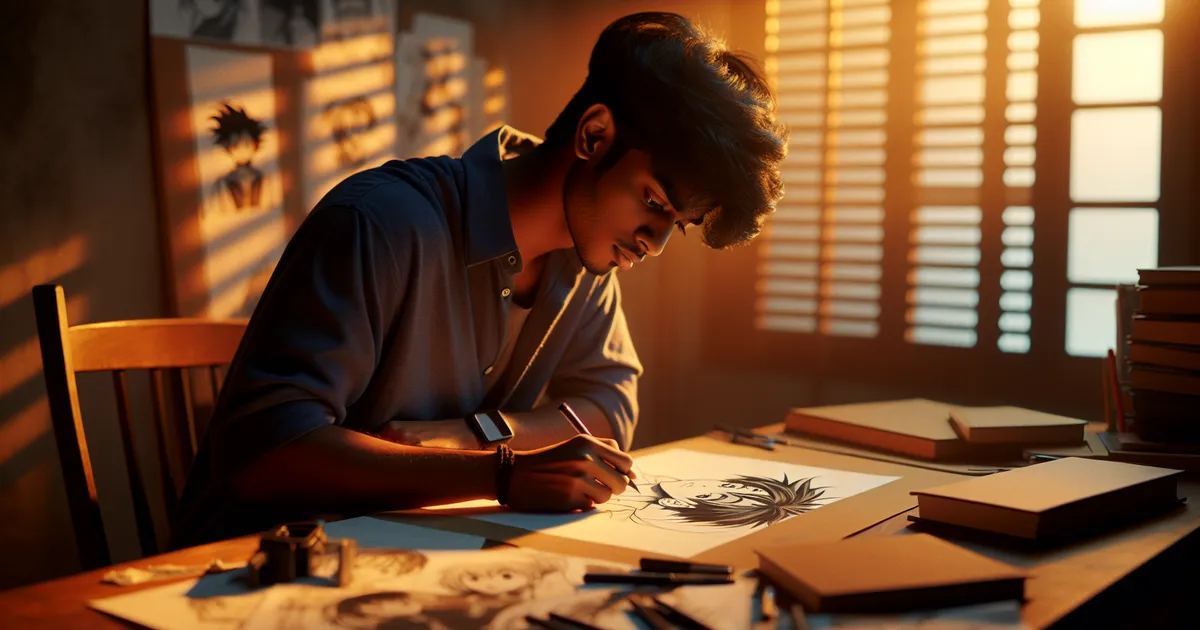
Thinking anime drawing is simpler leads to stagnation—its abstractions demand a deeper grasp of anatomy than many beginners realize.
Learning anime drawing as a beginner is an exciting way to express your creativity while mastering the techniques of this unique art form. Anime drawing ventures into crafting characters and scenes in the unique visual style birthed by Japanese animation studios.
With its large expressive eyes, simplified facial features, and stylized proportions, there's an art to capturing the look.
Unlike general illustration, the style itself is the challenge.
In Anime Drawing, you engage in focused sessions of sketching, typically 10-30 minutes, where you practice anatomy and features of anime characters through targeted repetition, starting with warm-ups like drawing circles before moving on to copying poses and styles from references.
Anime Drawing creates a flow state through focused practice and rapid skill feedback, allowing for micro-improvements in anatomy and technique, which fosters a sense of accomplishment and engagement that replaces idle time with purposeful creativity.
You think anime drawing is the easy version of art. Simpler faces, fewer rules, shortcut to "good enough." That assumption is why most people plateau in the first month.
Anime isn't simplified; it's abstracted. Every design choice — eyes, linework, proportions — reflects a deliberate reduction of realistic anatomy. You still have to understand what you're reducing.
Drawing one good anime face might be luck. Recreating the same character from multiple angles and in varying emotional states is where the real skill gap shows.
The style has stricter internal rules than realism. Slightly off realistic proportions can read as stylized. But break anime proportions incorrectly and it just looks wrong — the audience has internalized the visual language more precisely than most beginners expect.
One working animator described learning anime drawing as a deeper lesson in facial muscle structure than any life drawing class she'd taken. She had to reverse-engineer why every simplification worked before she could apply it deliberately.
Copying gets you started. Understanding gets you unstuck. The gap between those two is where most anime beginners stall — and it's smaller than it looks once you know what to study.
Drawing anime feels awkward at first. You're capturing a style you've only admired from a distance. It's like transcribing a foreign language without knowing the alphabet.
The real issue is not skill — it's learning the shortcuts artists use.
In the first week, basic shapes feel foreign and expressions go flat or haywire. Your drawing looks off and you can't pin down why. This isn't failure — it's your eye starting to see the disconnect.
Around week three, one element, like eyes or linework, makes sense, while the rest remains elusive. By the fourth week, you'll have two drawings you're okay with and a pile you'd rather not think about again.
Anime isn't about realistic anatomy — anime proportions follow their own logic. Copy from one specific anime artist you admire, not photos of real people, for better results. The next section covers the mistakes that keep beginners stuck in that frustrating early phase far longer than necessary.
When to start: Morning
Duration: 1 hour
Cost to try: $20
Success criteria: If you sketch one anime character, ink the final lines, and make the pose readable without tracing, do session 2.
Tracing polished illustrations feels productive. But finished anime art hides the skeleton underneath — the basic shapes that make proportions work.
Find construction breakdowns of your favorite characters instead. Draw the basic shapes first, and ignore detailed linework until the proportions feel right.
Eyes feel like the natural starting point. They're expressive, they're fun, and most tutorials lead with them. The problem is that eyes drawn without a head shape to anchor them almost never land in the right place.
Start with the full head shape every time. Draw a horizontal centerline across it, then place both eyes symmetrically along that line. The head shape tells the eyes where to go — not the other way around.
Faces and hands get all the attention. The torso quietly ruins everything else. Weak body proportions undercut even a well-drawn face.
Use a site like Line of Action and run dedicated torso gesture sessions. Set the tool to bodies only and leave the head out of it entirely — forcing yourself to focus on the torso without the face as a crutch is what actually builds the habit.
Mechanical pencils feel precise and clean. That's exactly the problem. Smooth paper combined with a hard lead punishes hesitant strokes and rewards tiny, timid marks.
Switch to a 2B or softer pencil on toothy paper. The texture grabs the pencil and makes committed strokes feel natural. You'll draw with more confidence because the setup stops rewarding hesitation.
Endless revision on a single pose feels dedicated. It's actually a way of avoiding the discomfort of starting something new. The hundredth tweak teaches far less than the fifth completely different attempt.
Sketch your character in five distinct poses in a single session. The improvement that happens between pose one and pose five is more than you'll get from reworking one drawing all afternoon.
You can draw anime anywhere — a desk at home, a library corner, a coffee shop table. But drawing alone only gets you so far. Open drawing nights at art studios and community makerspaces are where anime artists actually cluster. Anime is standard fare at these events, not a niche outlier.
Finding people online first is usually the faster move. Search Meetup.com for "anime art," "manga drawing," or "figure drawing" paired with your city name. Facebook Groups respond well to searches like "[your city] anime club" or "[your city] manga artists." Your city's subreddit is worth checking too — or post directly in r/learnart or r/AnimeArtistry and ask if anyone local is around.
When you show up or introduce yourself online, say you're a beginner working on fundamentals — that one line gets you useful feedback and maybe a regular drawing partner.
Chibi style uses oversized heads and tiny bodies. The exaggerated proportions mean anatomy errors disappear into the design — no other style hides beginner mistakes this well.
Shōnen action style — think Dragon Ball and Naruto — is built on heavy linework and dynamic poses. It demands anatomy and foreshortening earlier than any other style here, which makes it harder to start but faster to build real drawing fundamentals.
Shōjo style trades dynamic poses for soft lines and deeply detailed eyes. The focus is emotional storytelling over movement. If you skip this style assuming it's easier, you'll miss some of the most demanding eye and face work in manga.
Digital anime art — using tools like Clip Studio Paint or Procreate — is built around layers, lineart cleanup, and digital coloring. A mid-range tablet runs $50–$100 and eliminates the biggest frustration of traditional drawing: an errant line ruining a finished piece.
Original Character (OC) design means building a character from scratch — silhouette, color palette, personality. It draws on every other style listed here. This is where people who learned to copy other characters discover they can't yet invent one — which makes it the clearest signal of how far your skills have actually come.
If the texture of this appeals to you, Architectural Drawing is built on similar bones.
A close neighbor worth considering: Pencil Drawing.
Most beginners focus on line quality: cleaner strokes, steadier hands, better tablets. But the lines aren't the issue.
Reading proportional relationships as ratios is the key. In anime, the distance from chin to nose isn't a fixed number. It's a fraction of the face height, shifting with age, style, and emotion.
Learn to recognize when "this gap is roughly one-third of that gap" instead of memorizing where things go. Suddenly, every face style makes sense and can be replicated.
Memorized rules are brittle. An artist tilts a head. A child's face appears. The rules stop working and you're starting from scratch.
Seeing faces as systems of relationships changes that. You can deconstruct any style you encounter — without hunting for a tutorial that may not exist. Without this skill, every unfamiliar style feels like a new language rather than a dialect of one you already speak.
The next section puts this ratio-reading into practice with exercises built around real anime face styles.
Thirty days, twelve sessions. Plan for three times a week, each lasting about 30–45 minutes.
Anime drawing thrives on practice, not marathon sessions. Twelve attempts give you enough repetition to see real change without burning out.
If you're already thinking about your next character before the current session is over, that's not motivation — that's the hobby. The proportions don't need to be right yet. Learn one foundational concept per week — heads, then eyes, then expressions — before touching style.
If the sessions felt flat — no frustration, no pull — drawing without a reference or a character you actually care about will hollow out any session fast. Pick a specific anime series and use it as your reference point for two more weeks before writing off the hobby entirely.
If each session felt pointless and you weren't looking forward to the next one, that's a clean answer. Difficulty and disinterest feel different — one pulls you back in spite of itself, the other just doesn't. Spending more time on a hobby that doesn't grip you won't change the underlying signal.
You're pausing anime at odd moments to study shading, or screenshotting poses without thinking about it. That unconscious attention — noticing line work when you're not even trying to learn — is the clearest signal of genuine fit.
Anime Drawing is a deeper commitment than most boredom cures — for lighter options, check things to do when bored.
Most beginners see noticeable improvement within 3–6 months of consistent practice (3–5 hours weekly), though developing a personal style typically takes 1–2 years. The timeline depends heavily on your starting skill level and how much you practice.
At minimum, you need pencils (HB and 2B work well), erasers, and paper—total cost under $20 for basic supplies. As you progress, you might invest in fine-liners, markers, or digital tools, but they're not necessary to begin.
Anime drawing isn't harder—it's different. It emphasizes large expressive eyes, simplified facial proportions, and dynamic poses rather than realistic anatomy. Beginners often find it more approachable because the stylized forms are forgiving and easier to break down into basic shapes.
Yes, many self-taught anime artists succeed using free YouTube tutorials, online communities, and practice. Structure matters more than formal training—consistent practice and reference studies will accelerate your learning significantly.
Focus on understanding basic anatomy, proportions, and perspective; mastering character expressions and eye designs; and learning how to convey motion through dynamic poses and flowing lines. These fundamentals form the foundation before experimenting with more complex styles.
Free resources (YouTube, blogs) are abundant, while structured courses range from $15–$150 depending on depth and platform. Many beginners start free and invest in paid courses only once they've confirmed the hobby interests them.