BoredomBusted — Find Your Next Favorite Thing To Do
Discover hobbies, activities, places, and ideas that spark joy. Whether you're looking for something creative, active, social, or relaxing, BoredomBusted helps you find your next favorite thing to do.
Browse our hobby guides, things-to-do collections, and place ideas to never be bored again.
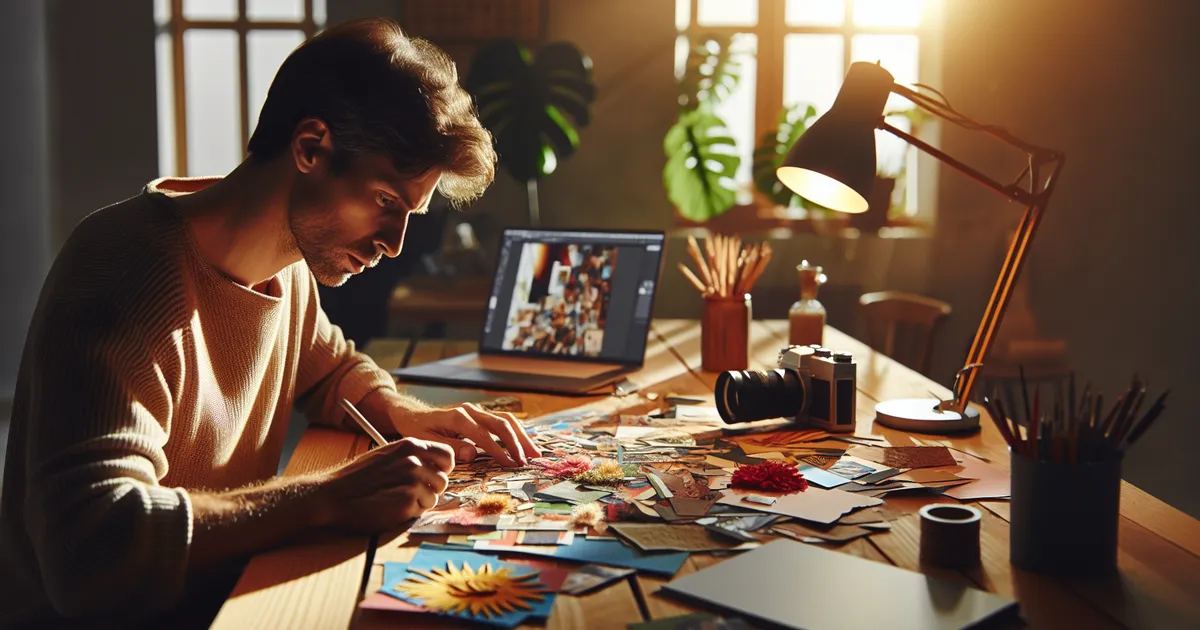
Collage isn't just childhood craft—it's a complex visual art training your eye to navigate hierarchy, tension, and resourcefulness with every cut and paste.
Learning collage as a beginner is an exciting way to express creativity through cutting and arranging various found materials like paper and fabric — then fixing them to a surface.
Unlike drawing or painting, you're editing reality, not inventing it from scratch.
The source material does half the work.
Your job is the arrangement.
In collage, you gather materials such as magazine clippings, fabric scraps, and paint, then cut, tear, and layer them on a substrate like paper or mat board to create visual compositions that express personal narratives and ideas.
Collage induces a flow state through its hands-on, immersive process, providing immediate visual feedback and the freedom to experiment, which fosters creative expression and a sense of accomplishment as you transform everyday items into art.
You think collage is something you do at age seven with safety scissors and a Highlights magazine.
Maybe you picture a vision board with magazine cutouts and motivational words in bubble letters.
That assumption is costing you one of the most compositionally demanding visual arts out there.
Hannah Höch was making sharp political commentary in 1919 by slicing apart newspapers and reassembling them into images that hit harder than any essay.
The medium wasn't a limitation. It was the point.
The technique has a longer history than you'd expect—and the materials you actually need to start are probably already in your recycling bin.
Creating your first collage can feel clumsy and frustrating. The blank page can intimidate you. Too many magazines, nothing in them feels right. Scissors might not cut cleanly, and glue can warp the paper.
You're accumulating more cut pieces and making decisions faster by your third session. You stop fussing about ruining things and start developing an intuition for color and scale.
You'll spend most of the first week staring at the pile, wondering what works. By week two, something finally comes together — maybe awkward, with off proportions, but satisfying nonetheless.
Around week three, the process clicks. You begin cutting pieces without a plan, yet it starts to feel right. By the fourth week, you'll revisit what you made earlier and clearly see what was missing then.
Struggling with too many images and disconnection isn't failure. It simply means your scrap library is in its infancy, and that's the real foundation for collage success, often overlooked until later sessions.
Try gathering pages that intrigue you before your first session, without analyzing why. Tear, don't cut, and stack them loose. This pile becomes your creative palette. Having a collection of scraps ready to go is always easier than starting from zero.
When to start: Morning
Duration: 1 hour
Cost to try: $5
Success criteria: If you create a glued collage with one clear focal image, at least 3 layered cutouts, and visible marker details, do session 2.
You're eager to start, but once you use adhesive, the layout is permanent.
Spend time arranging your elements dry. Then take a photo before you commit with glue.
Regular scissors ruin the edges. They create a rough finish that breaks the illusion of a cohesive piece.
Grab nail scissors for curves and a craft knife for straight lines. These tools prevent fraying and keep cuts clean.
Too much adhesive turns paper wavy and causes clips to lift.
Apply thin layers instead. First coat the surface, then lay down the paper. Seal with a light top layer.
When a small object sits next to a large one without clear intent, it creates confusion.
Look at your layout from a distance. If your eye can't easily find a starting point, rethink the scale.
A collage feels flat when all its elements are from one type of source.
Diversify your paper sources. Mix in vintage, contemporary, and textured papers, like newspaper or kraft. This creates depth effortlessly.
Collage works wherever space allows creative chaos. Home tables, art studios, and community center craft rooms are popular spots.
Local libraries often host free collage nights. Just show up and start cutting and pasting with others.
Walk in and say you've never done this before. This often gets you a seat at a well-stocked table and someone eager to share.
Collage enthusiasts love to show off their collections and process. Don't be shy—jump in and see what treasures are waiting to be shared.
Magazine clippings, printed photos, and a glue stick. The entry is practically frictionless.
No special skills or gear needed. Perfect for beginners who want to start making today.
You'll experiment in Photoshop, Procreate, or Canva – layering digitally instead of physically.
The undo button changes everything. Ideal for those who prefer zero physical mess, but expect a steeper learning curve.
Photo collages focus on storytelling with images. Your own shots or archival finds.
Narrative and juxtaposition take center stage. Great for photographers needing a creative outlet without the pressure of a perfect shot.
Mixed media goes beyond paper to include fabric, wire, and paint.
Best for those with foundational composition skills. Experimentation here is boundless, with budgets varying by material.
Decoupage involves adhering paper or fabric to items like furniture or ceramics.
Focus more on surface coverage than artistry. Perfect for those seeking functional, decorative results with a sealant under $10.
If the texture of this appeals to you, Etching is built on similar bones.
If the texture of this appeals to you, Pencil Drawing is built on similar bones.
If you want a related angle, Sketching is the natural next stop.
Most beginners focus on finding beautiful images, thinking the perfect magazine spread or color palette is the answer.
That's not what makes a collage work. The real secret is composition, specifically controlling visual weight.
Visual weight pulls the viewer's eye toward an element. A small dark shape can dominate a large pale one. Instead of asking if something looks nice, focus on where the eye travels and if that's intentional.
Understanding visual weight transforms your compositions. Without it, collages feel "off" and materials get blamed. But with it, you can fix a broken layout fast. Shift, crop, or add a small dark anchor, and balance returns. It also turns limitations into strengths, giving precise placement guidance with just three images.
Commit to six sessions over 30 days. About one and a half per week is just right.
Collage has a deceptive early curve. The first two sessions might feel like arts and crafts. Sessions three and four either spark something or they don't.
You find excuses to sit down again and again. You're tearing pages from magazines before the session even starts. This isn't just excitement—it's a sign that collage is integrating into your worldview.
Focus on a theme or constraint, like a color palette or a specific size. This gives collage an interesting direction.
Every session feels forgettable, with no real impact. This usually means it's not the medium but the pace or materials. Try a session with something completely different—maybe old technical manuals or street ephemera instead of magazines.
If that doesn't stir your interest, it's okay to let it go.
You are watching the clock and resenting the materials. This probably signals a texture mismatch. Collage can be slow and messy. If the quietness feels punishing, it's unlikely to change with practice.
The one sign you can't ignore: saving random items. You're keeping receipts, packaging, or a font you liked. That's collage thinking—intentional collection without a conscious plan.
Collage is one path among many — browse the full hobbies list to weigh it against the rest.
If nothing here clicks, our guide to what to do when bored covers shorter, lower-commitment options.
You'll need basic supplies: scissors, glue or paste, a surface like cardstock or canvas, and source materials like magazines, photos, newspaper, or printed images. Many beginners start with just a glue stick and torn magazine pages—no special tools required to begin experimenting.
A simple collage can take 30 minutes to an hour, while more complex pieces with multiple layers and detailed composition may take several hours across multiple sessions. The timeline depends entirely on your design, the amount of detail you want, and how you work.
No experience necessary—collage is one of the most accessible art forms because there's no 'wrong' way to arrange images and textures. Your own choices about color, placement, and meaning are what matter, making it perfect for beginners and experienced artists alike.
You can start for under $10 with scissors, glue, and recycled materials from around your home. Budget between $20–50 if you want quality supplies like archival-safe glue, better scissors, and paper stock—collage remains one of the cheapest creative hobbies to begin.
Both are valid—digital collage uses image editing software and layers digital photos or graphics, while traditional collage involves physical cutting and pasting. Many artists use both methods, so choose based on what appeals to you or what tools you have access to.
Collage is about intentional composition and meaning—you're layering images and textures to create a new narrative or emotional impact that the original images didn't have alone. The 'magic' happens when disparate elements combine to tell a story or express something uniquely yours.