BoredomBusted — Find Your Next Favorite Thing To Do
Discover hobbies, activities, places, and ideas that spark joy. Whether you're looking for something creative, active, social, or relaxing, BoredomBusted helps you find your next favorite thing to do.
Browse our hobby guides, things-to-do collections, and place ideas to never be bored again.
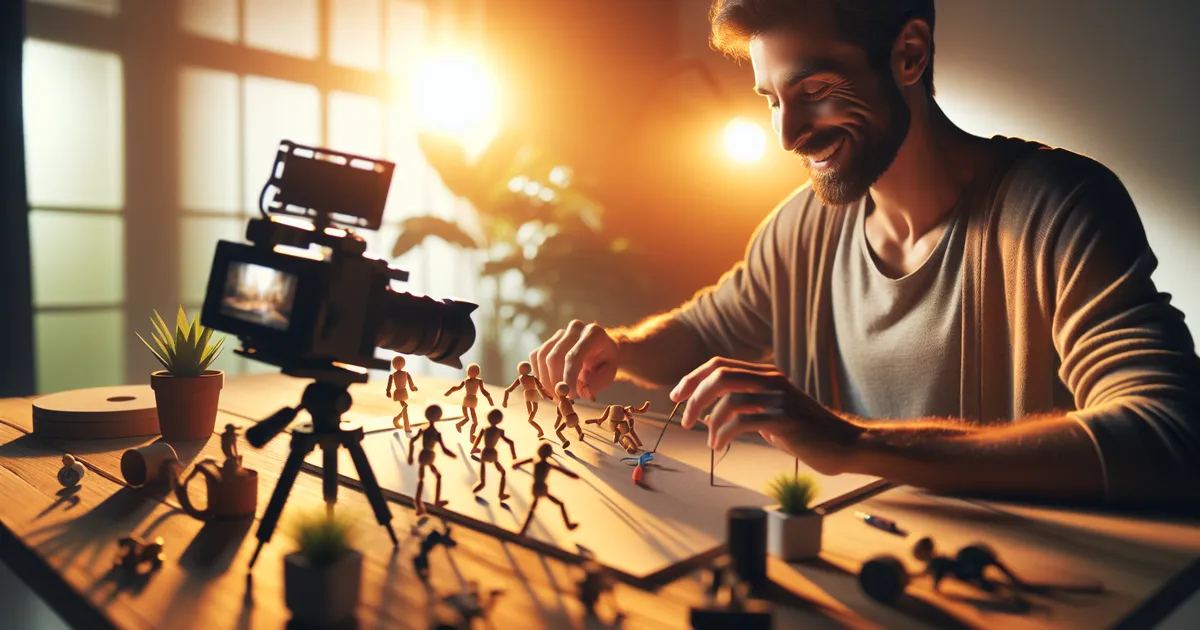
Stop motion animation isn't just kids' play — it's a craft that can reshape how you perceive movies, using just a phone and meticulous frame-by-frame control.
Learning stop motion animation as a beginner is a fascinating journey that involves photographing physical objects one frame at a time, moving them slightly between each shot.
Then play the images in sequence to create the illusion of movement.
Unlike drawing or digital animation, every frame exists in the real world before the camera ever clicks.
In stop motion animation, you photograph objects or scenes in tiny increments, taking hundreds or thousands of individual frames while making precise adjustments between shots to create movement. You plan scenes, develop storyboards, and assemble photos into sequences using software, focusing on timing and aesthetics to achieve smooth animations.
This hobby engages you in creative planning and technical precision, providing a sense of accomplishment and satisfaction as you see your ideas come to life, which can alleviate feelings of emptiness or restlessness.
You think of stop motion as a kids\' craft. Paper cutouts, clay blobs, maybe a school project. It seems quaint and simple, not a real hobby.
You're missing out on a hobby you can start with just a phone and a lamp.
Aardman Animations built Wallace & Gromit one frame at a time in a cold Bristol warehouse. Not with magic, but by moving a dog's eyebrow 2mm with tweezers. Those reference marks on the floor, that practice underpins everything you can try, right at home.
Stop motion lets you sculpt time itself. Most people never develop this ability – it transforms how you experience films forever.
The next section reveals how affordable it is to start right now.
Watching a Claymation short or a Wes Anderson film makes stop motion look meditative. Deliberate. Almost relaxing.
It is not relaxing.
Your first session is you moving a clay figure two millimeters, taking a photo, moving it again — and then realizing forty minutes in that the lighting shifted. Every single frame looks different. That one session teaches you more about stop motion than any tutorial will — because now you understand why experienced animators tape their lamps down, mark their subject's exact position, and check for accidental nudges before every shot.
Week one, you shoot something and play it back — your subject vibrates like it's having a seizure because your hands weren't steady and your camera shifted between shots. Week two, you rig a basic mount and get your first 10 frames that actually look intentional. It's a small thing that feels enormous.
Week three is where the math hits you. Twelve fps means 12 photos per second of footage — so your "30-second film" just became 360 individual shots. Most beginners quit here, right when the process is about to start making sense. Week four, if you push through, you finish something rough and short and a little jerky — and you watch it on loop more times than you'll admit.
The difference between quitting and pushing through usually comes down to one physical detail: whether your shooting surface is locked down. Before session one, tape a printed grid sheet under your subject and mark its exact start position with a small piece of painter's tape. Accidentally bumping your figure and not knowing where it was is the single fastest way to ruin a sequence — and it's also the most avoidable mistake beginners make. The next section covers that one and the rest.
When to start: Morning
Duration: 1.5 hours
Cost to try: $15
Success criteria: if you finished without finalizing a polished animation, do session 2.
You adjust your angle mid-scene to get a better look at your subject – and now your background has jumped three inches to the left.
Lock your camera down before shot one – a $10 tabletop tripod with a twist-lock head will hold position better than any stack of books you've improvised.
12 frames per second is the minimum for smooth-looking motion, but beginners shoot 4 or 5 and wonder why their film looks like a slideshow having a seizure.
Shoot at least 12 fps – and plan your shot counts before you film, because running out of frames mid-movement is how scenes die.
A puppet's arm moves halfway across its range in one frame, and suddenly your character looks like it's teleporting instead of waving.
Move 2–3mm at most per frame for anything that needs to feel natural – measure against a reference mark if you have to.
Overhead fluorescents and window light both shift constantly – your camera catches it, and every frame has a slightly different exposure.
Switch to a dedicated LED panel on a dimmer, and tape over any windows in your shooting space so the light stays dead consistent.
Your character drifts a millimeter every few frames because nothing is holding it in place – by frame 40, it's walked itself off the table.
Use small blobs of museum putty under your subject's feet, or drill tie-down points into your set surface if you're using wire-footed armatures.
Most stop motion animation happens right at home. All you need is a table, a lamp, and a phone tripod.
Maker spaces and community arts studios hold animation nights, offering shared equipment and space.
Let them know you're just starting out and share your work. This honesty usually leads to quick equipment tips and someone offering to help with your setup.
Clay figures allow you to change a character mid-scene without starting over. This flexibility is perfect for beginners seeking expressive characters on a budget. A basic polymer clay kit runs $15–30 and lasts for months.
Cut-out animation uses flat, jointed pieces of paper or cardboard. Movement is easier to control, and fixing errors is a breeze. Great platform for exploring narrative ideas if 3D feels intimidating right now.
Rely on everyday items like toys or food to animate your scenes. No construction required. Ideal for jumping right into animation without any upfront crafting.
Professional studios often use puppets with wire armatures to achieve precise movement. Suited for animators ready to level up with smoother motion control. Gear costs start around $50–200.
Pixilation uses real people for animation by photographing them pose by pose. Achieve a unique visual style without resorting to props or sculpting.
Readers who enjoy this often gravitate toward Etching next.
For something adjacent, see Pencil Drawing.
Sketching is a sibling pursuit and often surfaces the same kind of curiosity.
Most beginners spend all their energy making characters look good between shots – better clay, better props, better lighting rigs.
The frames themselves are pretty. The movement is dead.
The one skill is anticipation timing: knowing exactly how many frames to hold a pose before the action, not just during it.
In stop motion, movement reads as intentional when the audience's eye is "primed" before it happens.
You do that by holding the pre-action pose one to three frames longer than feels natural – a character leaning back before stepping forward, a hand tensing before grabbing.
Without it, even smooth frame-by-frame movement looks like an object being nudged.
With it, it looks like something deciding to move.
Your characters stop looking manipulated and start looking motivated – that's the entire difference between amateur and professional stop motion.
Without anticipation, viewers can't read intent, so every action feels random even when the pose sequence is technically correct.
Smooth isn't the goal. Readable is.
Forget whether you'd be good at it. The only question worth answering right now is whether it's worth 30 days of your actual time.
Six sessions over 30 days — roughly one every five days. Each session should run at least 45 minutes, which is enough time to shoot a short sequence, review it, and feel something about what you made.
Six sessions won't make you skilled. They'll tell you whether the process itself holds your attention — which is the only thing that matters at this stage. Stop motion rewards the spacing too. A few days between sessions gives you enough distance to watch your footage without flinching, adjust, and go again.
If you're mentally rearranging shots while doing dishes, or you've already started building a second set without planning to, that involuntary drift into the work is the hobby announcing itself. Start a simple shot log and buy a cheap turntable or slider before you touch anything else — your instinct right now is to complicate the visuals, and controlled movement will do more than a better camera.
If you finished all six sessions but felt no particular pull to return — no dread, no excitement — try one session with a completely different subject matter before writing it off. Stop motion's appeal is often genre-specific: clay reacts differently than paper cutouts, and object animation feels nothing like puppet work. The medium may not be the problem.
If you were watching the clock and resenting the tripod, that's a clean answer. Stop motion is structurally slow — it punishes impatience at every single frame, not just occasionally. If the pace felt hostile rather than meditative, a faster visual medium like flipbook animation or short-form video editing will suit you better.
You watched a stop motion film — a Laika feature, a two-minute YouTube short, anything — and immediately wanted to know how a specific shot was made. That hyper-specific pull toward the mechanics, not the finished film, is the clearest early sign this hobby has a grip on you.
If your living situation is genuinely unstable or shared, stop motion requires a setup that stays undisturbed between frames — sometimes for hours. A single nudged object mid-shoot means a visible jump cut you can't fix in post.
If repetitive fine motor tasks cause real physical discomfort, factor that in honestly. Resetting finger positions by millimeters, frame after frame, while hunching over a small set is the core physical experience of this hobby — not an occasional edge case.
Not ready to pick a hobby yet? The boredom busters page has smaller things to try first.
You'll need a camera or smartphone, a tripod, lighting setup, and a backdrop or set to work with. Beyond that, you can use everyday objects, clay, action figures, or craft materials—stop motion is flexible and doesn't require expensive gear to begin.
A short 30-second clip typically takes 8–16 hours depending on complexity and your experience level. Feature-length projects can take months or years, but most beginners start with simple 10–60 second animations to learn the fundamentals.
Stop motion has a gentle learning curve—the basic concept is simple, but mastering smooth movement and storytelling takes practice. Most beginners can create their first recognizable animation within a few hours of trying.
You can start for free or under $50 using a smartphone and household items. A complete beginner setup with a decent camera, tripod, and lighting typically runs $150–$400, with professional gear costing significantly more.
Stop motion captures individual still frames of static objects, then plays them in sequence to create the illusion of movement—like a sophisticated flipbook. Regular video records continuous motion, while stop motion lets you move objects between each frame to create animation.
Yes, smartphones are excellent for stop motion and come with built-in cameras and free apps designed for frame-by-frame capture. Popular apps like Stop Motion Studio or FiLMiC Pro make it easy to create professional-looking animations on a budget.