BoredomBusted — Find Your Next Favorite Thing To Do
Discover hobbies, activities, places, and ideas that spark joy. Whether you're looking for something creative, active, social, or relaxing, BoredomBusted helps you find your next favorite thing to do.
Browse our hobby guides, things-to-do collections, and place ideas to never be bored again.
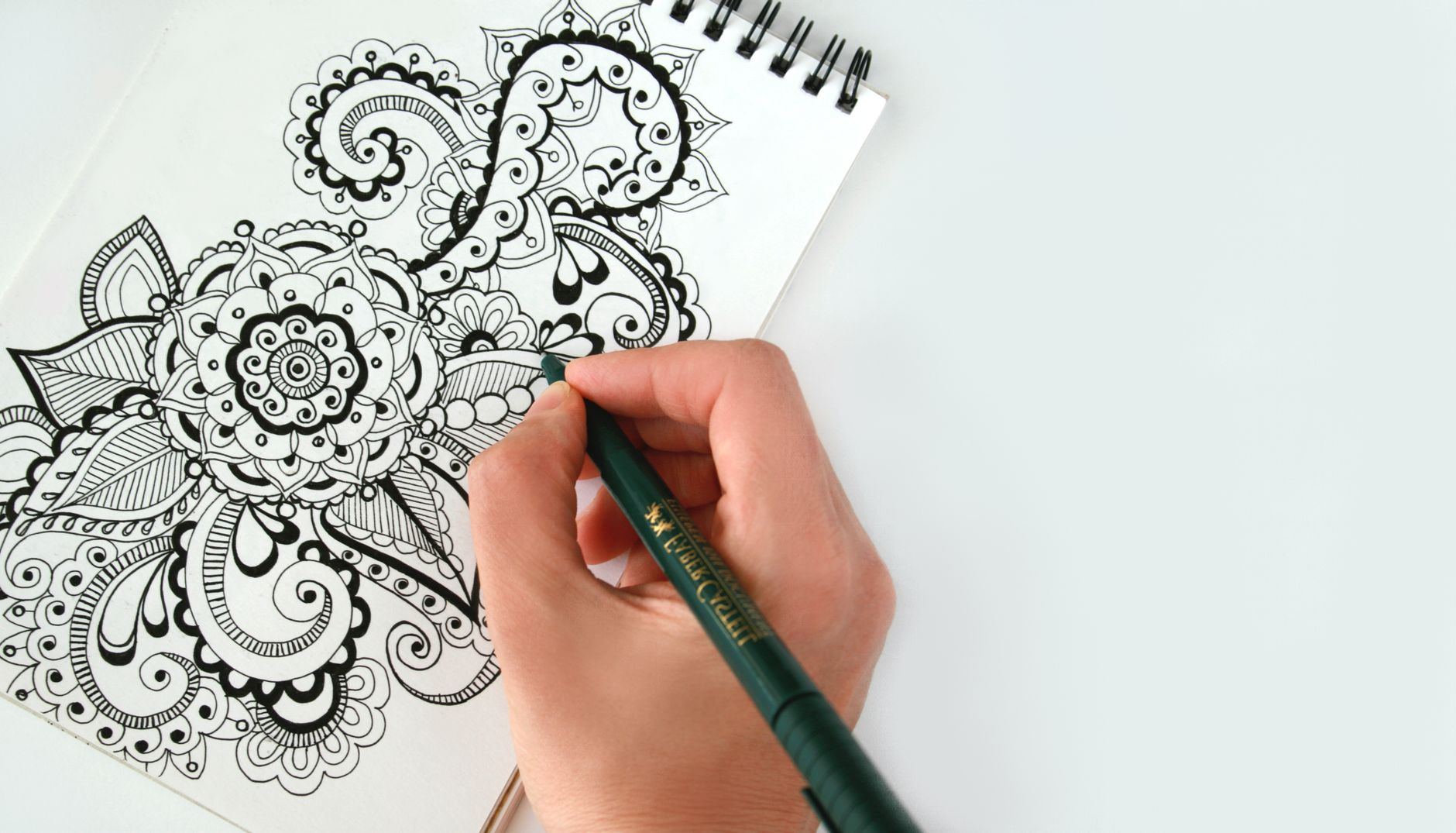
Zentangle works because it removes decisions: no eraser, no subject, no finished picture to aim at. The constraints do the drawing for you.
Zentangle is a drawing method where you build a small abstract picture out of simple repeating patterns, one pen stroke at a time. There is no subject to get right, no eraser, and no finished picture to aim at. Rick Roberts and Maria Thomas created it, and Zentangle is a registered method, which is why trained teachers carry the title Certified Zentangle Teacher.
A session happens on a 3.5-inch square paper tile. You mark four dots in the corners, draw a border, then sketch a loose pencil squiggle called a string that splits the square into sections. Each section gets a pattern, called a tangle, built from basic strokes: lines, curves, dots, circles, and S-shapes.
Finish with light pencil shading and your initials. A tile takes 15 to 30 minutes, and it almost always looks better than you expect. Drawing in a similar style without following the method is called Zentangle-inspired art, a perfectly good hobby of its own.
You draw four corner dots, a border, and a loose pencil string on a 3.5-inch tile. Each section gets a repeating pattern called a tangle, then you shade and sign. The method, created by Rick Roberts and Maria Thomas, forbids erasing and planning ahead.
Zentangle gives your hands one small job at a time: the next stroke. That single-task focus quiets the urge to switch tabs, and every tile ends with something finished to look at. New tangles keep it from going stale, since the pattern library is huge.
Zentangle gets filed next to adult coloring books: pretty, soothing, a little fluffy. Then you sit down with a pen and find out it is a method with rules.
Pen goes on paper, and it stays there. No erasing. No planning the finished piece.
The method removes decisions on purpose, so your attention has nowhere to go except the next stroke.
That is why people who swear they cannot draw end up with a tile they would hang on the fridge. The structure carries the skill. You supply the patience.
The tangle library is huge, and every tangle is a small puzzle in stroke order. You learn to read a pattern as a short sequence of moves, then recombine moves into patterns you invented. That is real visual skill, built quietly.
Zentangle does not promise therapy, and nobody should sell it as a cure for anything. What it reliably gives you is twenty minutes of single-task attention and a small piece of art at the end. For a brain that has been juggling twelve tabs, that is the whole appeal.
The method is also taught, not just practiced. Certified teachers complete training with the founders' company, and official classes follow a set structure. You can skip all that and learn from free tutorials, but it tells you this is a craft with a curriculum.
Session one starts with a small shock. Drawing a pen border on a blank tile feels like signing a contract you have not read.
The string is the next wobble. You draw a loose pencil squiggle, then stare at the sections it creates and wonder which pattern goes where.
Pick any section and any simple tangle, and start. The decision gets easier after the first stroke.
Halfway through, the tile looks messy. Lines overlap, one pattern is bigger than its neighbor, and your hand cramps from gripping the pen like a hostage negotiator. This is normal, and it fixes itself when you shade.
Shading is the moment people say "oh." Soft pencil along the edges of the patterns makes a flat drawing look like it has depth. Most first tiles go from forgettable to surprisingly good in about five minutes of shading.
By session two you notice patterns everywhere: floor tile, fabric, a neighbor's iron gate. By session three you have a favorite tangle, and you are slightly bored of it. Boredom here is useful, because it sends you hunting for a new pattern to try.
Be honest with yourself about one thing. Some sessions drag, your mind wanders to your phone, and the tile feels like busywork. If that is most sessions, that is data too.
When to start: Any quiet evening, preferably before you start scrolling
Duration: 20–30 min
Cost to try: Free (any pen and a square of printer paper)
Success criteria: If you finish the tile without erasing and want to start a second one, do session 2.
The method is designed around no erasing, and the reason is practical. Erasing turns every stroke into a test you can fail.
Wobbly line? Make it part of the pattern. Add a second line beside it, thicken it, or turn it into a curve.
Most wobbles disappear by the time you shade.
Beginners try to design the whole tile before the first stroke. That is the exact habit the method is built to break.
Draw the string, pick a section, and start. If you cannot decide on a pattern, pick the one you can draw without looking at a diagram.
Social media loves dense, dramatic tangles with twenty steps. They are fun later and frustrating on day two.
Start with patterns of three to five strokes. Wins early on keep you coming back for tile number ten.
A tight grip makes shaky lines and a sore hand. It also makes the session feel like work.
Loosen your fingers, rest your forearm on the table, and take a break every tile. Long sessions hunched over a small square can strain your neck and wrist, so stand up and stretch between tiles.
Unshaded tiles look flat, so people think they failed. Heavy shading smudges and turns the whole tile gray.
Use a soft pencil with light pressure, shade along the edges of patterns, and smudge gently with a fingertip. Stop sooner than you think you should.
Zentangle is quieter than most hobbies, but there is an actual community around it, and it is friendly to beginners.
Zentangle's official website, zentangle.com, keeps a directory of Certified Zentangle Teachers, often shortened to CZT. Many teach small classes in libraries, art centers, and private studios, and some teach online. Class prices vary by teacher, so check the listing before you book.
Check your public library for adult craft hours. Look at community education programs, senior centers, and art supply or craft stores, which often post workshops. Meetup is worth a search for "Zentangle," "drawing," and "art journaling."
The subreddit r/zentangle is active and kind to beginners, and people post finished tiles for feedback. r/Doodles is looser and good for the Zentangle-inspired side of things. Facebook groups for Zentangle exist too, and many local teachers run their own.
Post your first tile anywhere that welcomes beginners. The responses tend to be generous, and seeing other people's tiles is the fastest way to find new patterns to try.
Zentangle has a core method and several branches. Pick the one that matches what you want from the hour.
Stick with the official 3.5-inch tile, a black pen, and a pencil. The small size keeps each session short, and the repeated structure is what makes it feel like a ritual.
Work on larger paper or a sketchbook page and use the same pattern vocabulary. This is where people make posters, journal pages, and gifts. It is not the formal method, but it is where many people end up.
A Zendala is a mandala-style piece drawn on a round tile, built from tangles arranged in rings. It suits people who like symmetry and a more finished look.
Zentangle sells black tiles for use with a white gel pen and tan Renaissance tiles for use with a white charcoal pencil and a sepia pen. The change of palette makes familiar tangles look new.
A Certified Zentangle Teacher can fix your grip, spacing, and shading in one session. It is the quickest way past the plateau where every tile looks the same.
Beginners think the skill is artistic talent. It is not. The skill is breaking a pattern into its next stroke and trusting the sequence.
Every tangle is a short list of moves. Draw a curve, add a second curve, fill the gap, repeat. If you stop judging the whole tile and only ask "what is the next stroke," the pattern builds itself.
Pick one simple tangle, such as Hollibaugh or Crescent Moon, and find its step-out, which is the stroke-by-stroke diagram the community shares for each pattern. Draw only three rows of it, slowly. Cover the diagram and draw one more row from memory.
Do that for a week with one tangle per day. Then look at a pattern in the real world, like a woven basket or a tile floor, and try to write out its steps. That step-out habit is what separates people who copy tangles from people who invent them.
It fixes the fear of the blank section. A section is no longer a space to fill beautifully. It is a place to run a short routine.
Spacing improves too. When you only commit to the next stroke, you notice where the pattern wants to end, and you let it meet the string lines instead of squeezing it into the corner.
Commit to 12 tiles in 30 days. That is about three sessions a week, enough to get past the awkward first tiles and see if you want to keep going.
Use cheap supplies, set a timer for 20 minutes, and finish each tile before you judge it. Judge the process, not the picture.
You reach for the pen on nights you did not plan to. Keep going. Buy official tiles, try a class, and start a tile collection.
You like the tiles but dread the drawing. The result appeals more than the process. Try looser Zentangle-inspired work in a sketchbook, or look at sketching.
You rush every tile and feel nothing. That is a fine answer. Repetitive pattern work is not for everyone, and nothing here needs a second chance.
If you are hurrying toward the shading stage every time, the stroke-by-stroke part is not doing its job for you. Slow down for two tiles and see if that changes. If it does not, you have your answer.
Zentangle is a specific drawing method created by Rick Roberts and Maria Thomas. You work on a small square tile, follow set steps, and build patterns one stroke at a time. Doodling is free-form and unstructured. Drawing in a similar style outside the method is usually called Zentangle-inspired art.
No. Every pattern is built from simple strokes like lines, curves, dots, and circles. There is no subject to draw, so you cannot get the proportions wrong. Most beginners finish a first tile they are surprised by, especially after adding light pencil shading at the end.
A black fine-line pen, a pencil, and a small square of smooth paper. Many people use a Sakura Pigma Micron 01 pen and official 3.5-inch tiles, but any fine pen and cut paper works for your first session. A Micron pen ($2–$4) and a pack of 21 official tiles ($13–$14) come to under $20.
Not exactly. Zentangle refers to the official method and its steps. Zendoodle and Zentangle-inspired art are informal terms for pattern drawing that borrows the style but may skip the tile size, the no-erasing rule, or other steps. Both are fine to practice, but they are not the registered method.
Many people say a finished tile leaves them calmer, and slow, single-task drawing is a reasonable way to unwind. It isn't a medical treatment, so treat it as a focused creative break, not a cure.
Start with the teacher directory at zentangle.com, which lists Certified Zentangle Teachers by location, including online classes. Libraries, art centers, senior centers, and craft stores also run workshops, and Meetup is worth a search. Class prices vary by teacher, so check the listing before you book.