BoredomBusted — Find Your Next Favorite Thing To Do
Discover hobbies, activities, places, and ideas that spark joy. Whether you're looking for something creative, active, social, or relaxing, BoredomBusted helps you find your next favorite thing to do.
Browse our hobby guides, things-to-do collections, and place ideas to never be bored again.
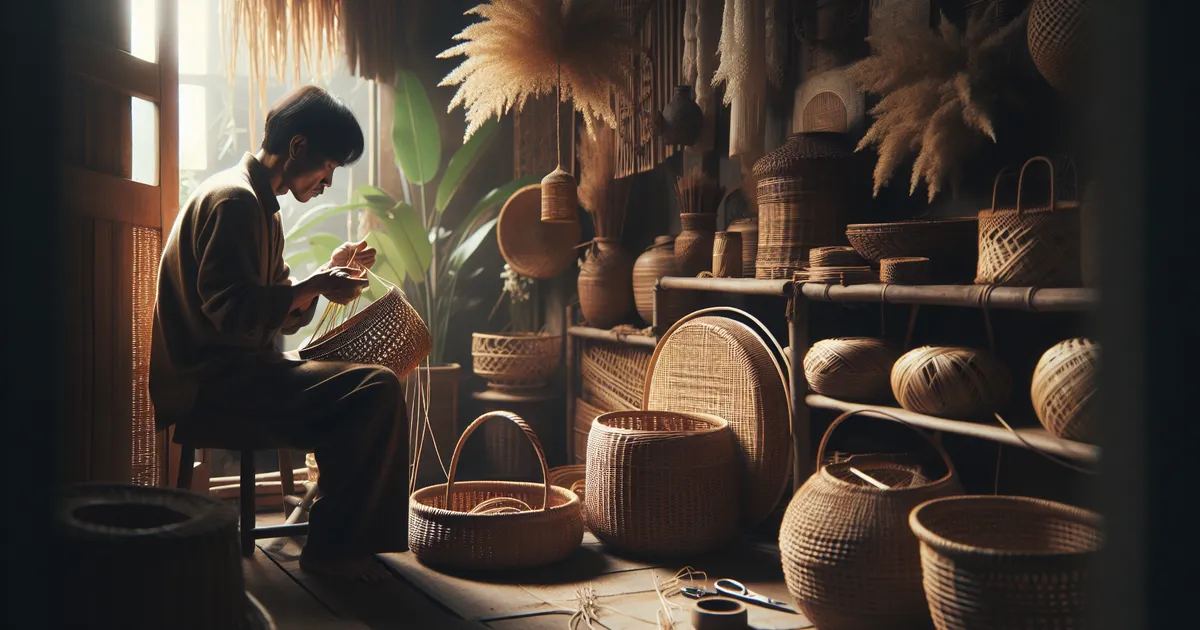
Basket weaving isn't just a quaint hobby; it's a complex discipline of structural engineering that demands rigorous skill and material mastery.
Learning basket weaving as a beginner involves understanding the fundamental techniques of interlacing various flexible materials to create unique three-dimensional structures. No molds. No machinery.
You're essentially creating fabric in three dimensions, with structure built in from the start.
Unlike knitting or crochet, the finished object holds its own shape without blocking, pinning, or any support at all.
In basket weaving, hobbyists select and prepare flexible natural materials like willow and rattan, soaking them to enhance pliability, and then construct baskets through techniques such as coiling or rib-style weaving, engaging in repetitive actions like interlacing and twisting strands around a frame while maintaining tension and adding new weaver lengths as they progress.
Basket weaving fosters a flow state by balancing the challenge of mastering intricate techniques with the tactile feedback of immediate results, while also satisfying creative expression through novel improvisations with materials, ultimately providing a tangible sense of accomplishment as hobbyists transform simple vines into functional art pieces.
You think basket weaving is what your grandmother did at a community center on Tuesday afternoons. Slow, simple, a little dusty. You're already half-checked out — and that assumption is exactly why most people never discover one of the most technically demanding fiber arts out there.
Basket weaving is structural engineering at a small scale. Every stake, every row of weavers, every tuck at the base is load-bearing geometry — get it wrong and the error compounds with every row above it, leaving a lopsided mess that won't hold its shape.
The materials alone are a discipline. Reed, rattan, ash splint, seagrass, and willow all behave differently under tension. Learning to read how a material wants to move takes months — and that's before you attempt anything with a pattern.
A first-time weaver building a simple market basket will spend twenty minutes just soaking reed to the right flexibility. Then another hour fighting the base stakes into a flat, even start. Indigenous and folk traditions built entire economies around mastering exactly this — the technique for a tight twill plaited base took generations to refine.
The materials. The tension. The geometry.
They're not separate problems — they're the same problem, and you're solving it every single row. The next section covers what you actually need to sit down and start.
Weaving a basket seems serene when you watch someone else do it. The rhythm looks soothing. Almost simple.
Your first attempt will shatter that illusion fast. Reeds scatter everywhere. The tension feels wrong and mismatched.
You'll question if it's the measurement or just you. But when the reeds finally weave into a consistent base and you sense the right tension by touch, it starts making sense.
Soak your reed coils for at least 20 minutes, then wrap them in a damp towel while you work. Keeping reeds damp isn't a prep step — it's a continuous requirement that determines whether your session is functional or a write-off. The next section covers the mistakes that keep beginners stuck before they ever get that far.
When to start: Early morning
Duration: 1 hour
Cost to try: $15
Success criteria: If you weave a flat basket base with a visible over-under pattern and even edges, do session 2.
Dry reed is your worst enemy. It snaps and splits, leaving you frustrated.
Soak your reed in warm water for 10–20 minutes before starting. If it starts getting stiff during your project, use a damp towel to re-moisten it.
Round bases trick beginners because they require skill in managing spoke spacing.
Begin with square or rectangular bases. It's easier to keep spokes evenly spaced and focus on learning the weaving basics.
Just as you're about to finish, you ease up. This is a common mistake.
Firmly push each row down toward the base. Your basket should be tight enough not to shift when squeezed.
You measure spokes for the basket body but forget length for the border fold.
Add 6–8 inches extra to every spoke. That ensures you have enough material to finish properly.
Craft store reed is often inconsistent and frustratingly brittle.
Order from a basketry supplier and request #3 or #4 round reed. The consistency makes a huge difference.
Basket weaving happens in craft studios, community centers, and fiber arts workshops. Sometimes it's the back room of a yarn shop. Sometimes it's someone's backyard.
The fastest move is searching Facebook Groups for "basket weaving [your city/state]" or "fiber arts guild [your region]." These are often the most active local communities online.
For something more structured, BMANA has a guild directory at bmana.org with state listings — a solid way to find an established local group. On Meetup.com, searching "basket weaving" or "fiber arts" often surfaces craft nights in smaller cities that rotate through different crafts, weaving included. Your local cooperative extension office is another overlooked option — 4-H and extension programs regularly run affordable weaving workshops.
Once you've found a group, showing up is the easy part. The one sentence that opens every door: "I've never done this before — what do I need to start?" You'll skip the first-hour confusion, get help sourcing materials, and almost certainly find someone who'll walk you through soaking the reeds.
Wrap rope, grass, or reed in coils and stitch them upward. A slow rhythm with forgiving structure. Ideal for beginners seeking one-directional, simple motion.
Use flat materials like cane or fabric strips in a grid pattern. Mistakes are obvious. Ideal for precision lovers who enjoy pattern-driven tasks.
Twist two weavers around each other through the spokes. Offers more structural integrity. Perfect to learn after mastering basic coils.
Replace fibers with memory wire, which maintains shape effortlessly. Great for modern, space-saving projects. Costs $20–$40 versus $10–$15 for reed.
Use rolled newspaper tubes instead of reed. Cheap and sturdy. An honest start if you're hesitant to invest right away. Paint it to disguise its humble origins.
Another variant that pulls from the same roots is Technical Drawing.
For something adjacent, see Junk Journaling.
If you want a related angle, Architectural Photography is the natural next stop.
Beginners fixate on patterns — counting rows, matching colors, redoing sections.
The pattern isn't what makes or breaks your project. Tension is the one thing that determines whether your basket holds its shape or doesn't.
Feel your tension as you weave. Sense whether each strand sits snugly against its neighbor. Adjust with your thumb and forefinger before moving on.
That adjustment — right there, mid-row, before the problem sets — is what keeps your base flat and your sides rising straight instead of flaring out. A basket that leans can't be saved by any pattern.
Spoke weight, weaving rhythm, finishing knots — all of it depends on consistent underlying tension. Once you own that, every other technique you pick up actually works.
Six sessions over 30 days — roughly one or two per week, with enough space between them to notice whether you're looking forward to the next one or quietly relieved to skip it.
The first two sessions are mostly about getting your hands used to the materials. By session five or six, if the rhythm hasn't clicked, it probably won't — and that's useful information, not a failure.
If you're rearranging your schedule to fit weaving in rather than the other way around, that's not discipline — that's the hobby. The next move is to go narrower: pick a specific structure like twill or God's eye patterns, or find a local workshop where someone can show you tension and spacing in person.
If the sessions felt flat, ask yourself one honest question: was it boredom, or just unfamiliarity? Those are different problems — unfamiliarity fades, genuine disinterest doesn't.
If sitting down to weave felt like a task you were pushing through, that's a clean answer. Basket weaving is repetitive and slow by design — it's meditative only if the repetition settles you, not if it grinds on you.
The sign worth paying attention to: you're pausing in a shop to look at how a basket is constructed, or pulling up weaving videos at night with no project in front of you. That's not casual curiosity — that's the hobby already running in the background.
A simple beginner basket typically takes 3–8 hours, depending on size and complexity. More intricate designs with advanced weaving patterns can take 20–40+ hours. Your speed will improve significantly as you practice and build muscle memory with the techniques.
You'll need natural fibers like reed, willow, seagrass, or rattan, along with basic tools such as a weaving loom or frame, scissors, and a water spray bottle to keep fibers pliable. A starter kit costs $30–$75 and includes everything you need for your first few projects.
Basket weaving has a gentle learning curve—basic techniques like plain weaving are easy to pick up, usually within the first session. The difficulty increases as you explore patterns like twill or spiral weaving, but beginners can create functional, beautiful baskets from day one.
A basic starter kit ranges from $25–$100, including fibers and essential tools. Individual materials are inexpensive (fibers cost $5–$20 per pound), making it an affordable hobby where most of your investment goes toward supplies you'll use for multiple projects.
Yes, handwoven baskets are highly sought after and can be sold online (Etsy, craft fairs) or locally. Prices typically range from $30–$300+ depending on size, complexity, and materials, making it a viable side income once you develop consistent quality.
Reed and seagrass are ideal for beginners because they're forgiving, hold their shape well, and are widely available and affordable. Willow is also excellent but requires more soaking and handling experience, so save it for when you're more comfortable with the basics.