BoredomBusted — Find Your Next Favorite Thing To Do
Discover hobbies, activities, places, and ideas that spark joy. Whether you're looking for something creative, active, social, or relaxing, BoredomBusted helps you find your next favorite thing to do.
Browse our hobby guides, things-to-do collections, and place ideas to never be bored again.
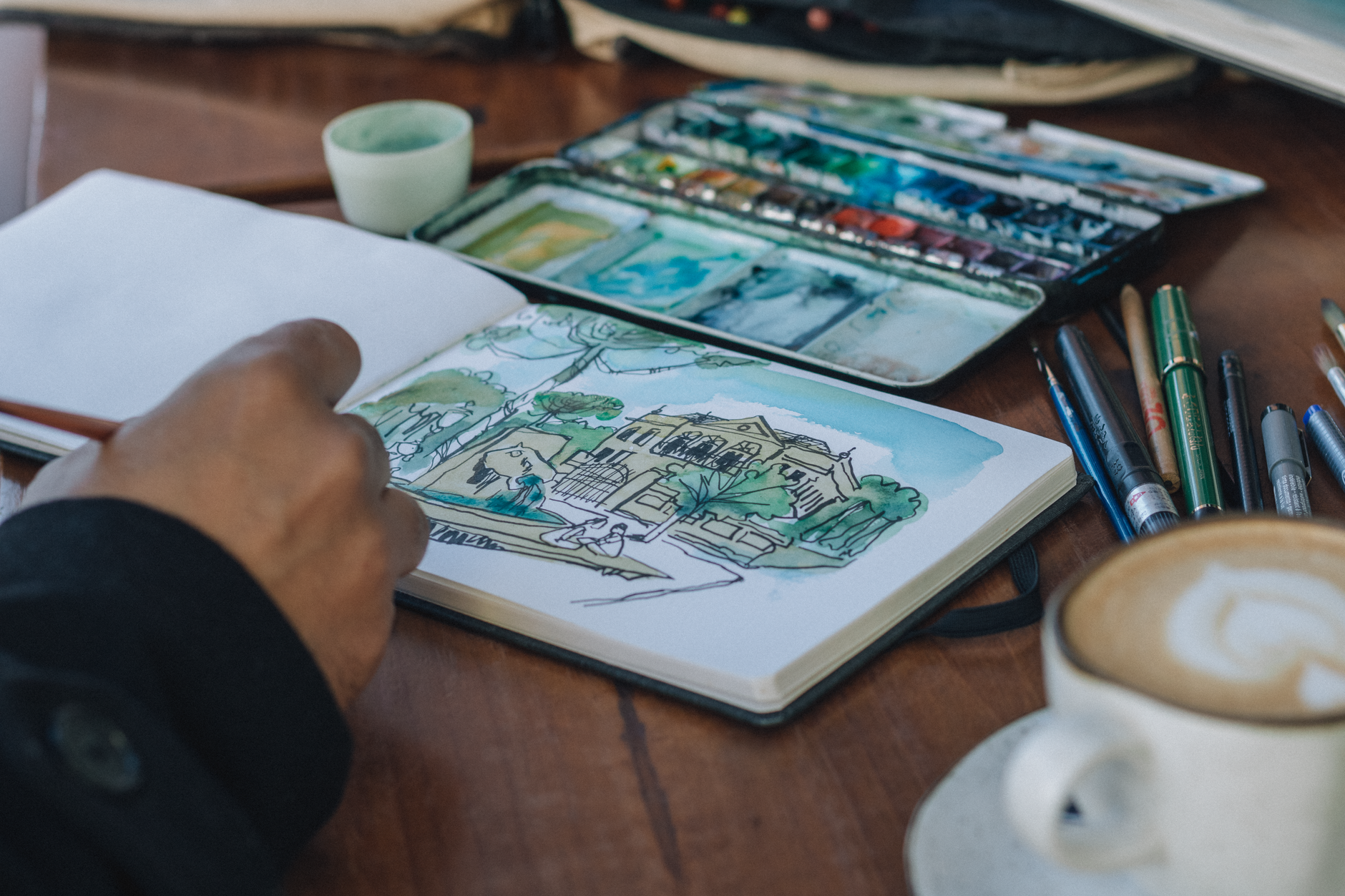
Urban sketching rewards finished, imperfect drawings: a wobbly bus stop you completed teaches more than a perfect cathedral you abandoned.
Urban sketching is drawing a real place while you are standing or sitting in it: a café corner, a bus stop, a market stall, a bridge. Unlike general sketching from photos or imagination, you draw what is in front of you, on the spot.
A session runs 20 to 60 minutes. You pick a spot, block in the main shapes with a pencil or go straight in with a waterproof pen, then add watercolor if you packed it. People walk through your view and the light shifts, but you finish anyway.
The movement runs through Urban Sketchers, a nonprofit that grew out of a 2007 Flickr group started by journalist Gabriel Campanario. Its manifesto is short: draw on location, tell the story of where you live and travel, and stay truthful to what you actually saw. Nobody grades the polish, and a drawing that is a little crooked still counts as a record of the day.
Urban sketching is drawing real places on location, from a café window to a street corner, in a sketchbook with pen and often watercolor. Sessions run 20 to 60 minutes, and the goal is an honest record of a place and a moment, not a polished picture or a perfect likeness.
Boredom often comes from seeing your surroundings as background. Drawing forces you to look at a scene closely for an hour, which makes ordinary streets new. It gives you a small project, a finished object at the end of each outing, and a reason to leave the house and sit somewhere new.
Most people file this under "pretty doodles in a notebook." That undersells it. Urban sketching is closer to field journalism with a pen.
You are recording a specific place at a specific hour, and a drawing made on location holds details a photo flattens: the sag of an awning, the guy in the orange vest, the exact way the light hit the bakery sign. Years later you remember the afternoon, not just the building.
It is also real training. Drawing from life forces you to judge proportion, perspective and light with your eyes, because you cannot zoom in on a crop. The skills carry into painting, illustration and architectural drawing.
The social side is more serious than it looks, too. Urban Sketchers has local chapters in cities around the world and an international symposium in a different host city, and people plan whole trips around sketching together.
Spoiler: the people who keep doing this are rarely the most talented ones. They are the ones who treat a wobbly drawing as a finished record, not a failure.
Session one is mostly deciding where to stand. You will walk past six perfectly good spots, pick the seventh, and then stare at a blank page for a few minutes. That is normal.
Your first drawing will look off. Buildings lean, proportions drift, and the cars look like loaves of bread. The mistake is judging it against Instagram sketchbooks, which are the best page from fifty bad ones.
Session two is where it gets easier. You already know what a 30-minute drawing feels like, so you start smaller and finish more. By session three you notice you are looking at street corners differently, picking out rooflines and shadows without trying.
Strangers will look over your shoulder. Most are friendly. A few will tell you their nephew is a great artist.
Pick a spot out of the way. Never set up in a roadway, bike lane, or doorway, and keep one eye on your surroundings, because you will get absorbed. Sit with your back to a wall if the street is busy, and keep your bag between your feet.
When to start: A dry morning or late afternoon, when light is soft and the street is not packed
Duration: 30–45 minutes
Cost to try: Nothing if you use paper and a pen you already own
Success criteria: If you finish a drawing and want to see how the next spot would look, do session 2.
The grand cathedral, the crowded plaza, the whole skyline. Those are the drawings people see online, so they try them first.
Start with one corner, one lamp post, one doorway. A small subject you finish teaches more than a huge one you abandon.
Beginners start with the pretty bits, like the ornate window trim, and work outward. The building then doesn't fit the page.
Draw the big outline lightly first, then place the details inside it. If the outline is wrong, you find out in ten seconds instead of forty minutes.
An eraser keeps you stuck on one line, chasing it. Sketchers who draw in pen often improve faster, because they learn to accept a line and keep going.
Use a pen and let the wrong lines stay. They add character, and the second attempt usually looks better right next to the first.
Paint on top of a drawing you are unsure of and you cover it in muddy puddles. Watercolor adds a second skill to learn.
Do your first ten sketches in pen only. Add a color wash once you can finish a line drawing without panic.
Wear sunscreen and a hat, bring water, and take a cheap folding stool or sit on a bench. Check where cars and bikes go. Be careful about leaving your bag out of sight, since it is easy to get absorbed and forget about it.
This is one of the easiest hobbies to find people for, because the organization is built around it. Skip the lonely-artist phase if you want.
Urban Sketchers (urbansketchers.org) is the global nonprofit behind the movement. It keeps a directory of local chapters, and many of them run regular free meetups. Show up with a sketchbook and a pen and you are in.
Chapters often post outings on Facebook groups, Instagram, and the Urban Sketchers website. Search "Urban Sketchers" plus your city name.
Meetup.com has sketching groups in most mid-sized cities. Look for "sketch crawl," "drink and draw," and "plein air" in the title.
Local art museums and community art centers often run low-cost drawing classes. Libraries host drawing nights, and some art-supply stores post free outings on a bulletin board. Cafés and breweries host drink-and-draw nights.
On Reddit, r/urbansketchers is the place for on-location work, and r/sketching and r/watercolor are good for feedback and technique questions. Post unfinished drawings, since people respond well to honest ones.
If you want a bigger trip, Urban Sketchers also runs an international symposium, hosted in a different city each time. It is several days of workshops and group sketch walks, aimed at people who have been at it for a while.
The same hobby, five ways. Pick the one that matches what you actually want out of it.
A waterproof fineliner and a sketchbook. No erasing, no color, no fuss. It is the closest thing to a default style, and it is the fastest way to get a drawing you are proud of.
Draw in waterproof pen, then add loose watercolor. The color can be sloppy because the lines hold the drawing together. Good for travel sketches.
Alcohol markers or brush pens give bold shapes quickly. They bleed through thin pages, so use paper made for them. Good for people who find watercolor fiddly.
Draw people at tables, on trains and waiting in line. They move, so you get one or two minutes per figure; capture the pose, not the face. A life drawing class is the fastest way to get better at figures.
Combine drawings with short notes about the day. Even one sketch per stop gives you a travel record a camera roll never will, and it pairs naturally with travel writing.
Beginners try to draw everything they see. Every window, every brick, every leaf. Forty minutes later the page is a mess and the drawing is only half done.
The skill that changes everything is simplifying a scene into three or four big shapes before you draw any detail. A street is a long box, a roof is a slanted slab, a tree is a blob on a stick. If the big shapes sit right, the drawing works even with almost no detail.
Before you draw a building, find the horizon line, which is simply your eye level. Hold your pen flat at arm's length and see where it crosses the scene. Every line that runs away from you slopes toward that height, which is most of what perspective actually is.
Do ten-minute thumbnails. Draw a postage-stamp-sized rectangle, sketch the scene with only big shapes and three tones (light, medium, dark), and stop. Do three of these before any real drawing.
Then do the real one. Add only the details that matter, and leave the rest blank. White space is a design choice, not unfinished work.
Commit to 12 sessions in 30 days. About three a week, each one 30 to 45 minutes, in a different spot. Keep one small sketchbook and one pen, and don't buy anything else yet.
You will have a sketchbook with twelve drawings, a few of which you like. You find yourself scanning for spots to draw on errands. That is the sign this fits you.
You enjoyed it but only when you were with other people. Find your local Urban Sketchers chapter before you decide, because the hobby may need company. Many people click with the group, not the solo drawing.
You dread each session and every drawing feels like a chore. That is real information, so let it go. The cost is a sketchbook and a pen, and you now see the place where you live a bit more closely.
If you keep making excuses before you leave the house but feel good once you are drawing, keep going. That is usually just startup friction. If you do not even feel better in the middle of a drawing, it is not for you right now.
No. Urban sketching is about observing and recording, not polish. Most chapters welcome total beginners. Start with simple subjects, use a pen so you cannot over-fuss, and finish each drawing even when it looks off. Skill comes from volume, so drawing a little every week matters more than natural talent.
A sketchbook and a waterproof pen are enough, about $16–$20 together. Add a pocket watercolor set and a water brush once you want color, roughly $30–$45 more. A pencil is optional, and a folding stool is a nice extra, not a requirement.
Mostly, but stay aware. Sit where you are out of traffic and doorways, keep your bag between your feet or against a wall, and look up often. Daytime sessions in busy, public places are the easiest. Going with a local sketch group is a good option for new spots.
Pick one small, still subject you can finish in 30 minutes, like a doorway, a lamp post or a café table. Skip crowds and big landmarks at first. Date the page and keep going even if it leans.
Urban sketching means drawing on location from direct observation, usually in a city or town, and it often includes everyday scenes and people. Regular sketching can be from imagination, photos, or still life. The Urban Sketchers manifesto adds a spirit of truthful, shared, on-the-spot drawing.
Check the chapter directory on the Urban Sketchers website, then search Meetup and Facebook for your city plus "Urban Sketchers" or "sketch crawl." Local art centers, museums, and libraries often run drawing nights too. If nothing exists nearby, post in r/urbansketchers to find other sketchers or start a casual meetup yourself.